
Characterizing The Hippie Language

Phyllis Fisher continued
From The West Coast Magazine
Auras and Alchemy III - Continuing Studies, Searching Auras
See today the whole universe, including every thing movable and immovable, all in one.
-Bhagavad Gita, XI.
"The specialized terminology of the hippie was either directly borrowed or broadly adapted from earlier American slangs. Many distinctive expressions can be traced, going backwards, to the N.Y. Greenwich Village Beatniks of the fifties, many of whom had migrated to the S.F. North Beach area.
There was sock-and-roller and hipster lingo, popster and cool talk stretching back into the forties, and jazz/jive talk which characterized the underground scene of the thirties. Two elements were carried through all the eras: drugs, which made for a covert, only-boys-allowed club context; and music, whose artistic expression and secret message lyrics were appreciated fully only by the initiated members of the associated social sub-group.
THE DICTIONARY OF AMERICAN SLANG,
in its 1960, pre-hippie edition, gives a very adequate definition and historic background for American hip lingo. For example, here are the entries for, ‘far-out,’ ‘like,’ and ‘too-much:’
|
Far out far-out
adjective
 1 Descriptives are 1 Descriptives are
at
Digger's Space.


The Temple of Solomon
Construction of Solomon's Temple

All people smile in the same language
|
Like 1 Used at the end of a sentence in place of “as”, “as if”, “it will be as if”, etc. 1956: “When he dies, I’ll be robbed like. I’ll have no more father.” S. Bellow, Seize the Day.
2 Used before nouns, adjectives, and pred. Adj., without adding to or changing the meaning of the sentence. Thus, “It’s like cold” = it is cold. Used by jazz, cool, beat groups, making a definite, forthright statement, part of the beat philosophy; reinforced by Yiddish speech patterns.
Too much 1 Beyond logical criticism or comprehension, in either a good or bad sense; ridiculously good or bad. Fairly common c. 1935 jive use; fairly well known general use since c. 1940.
Harlem slang example ~ scroll to bottom
Becoming a hippie meant more than lounging in the park and getting loaded. It required that you earnestly acquired the relevant terminology, mimicked the speech style of your peers, and so signaled that you too really understood what was happening, that you had taken that step to change your life from the inside out.
If you could comprehend the concepts of brotherhood and freedom and were aware of the thick and ceaseless reality of the natural world, you had to reject the bizarre and tragic responses of the American culture to that precious reality. You felt very lonely at first, until you realized you were already there, and there was a pretty friendly, socially active place."
In other words, how you talked showed where you were at, and the only rule was not to fake it. Indeed, “There are linguistic cues by which one who has had the zero(mystic)-experience recognizes another… even the most childish LSD talker can discern from a person’s talk, however erudite and technical or however simple, whether he has taken the drug or not.”
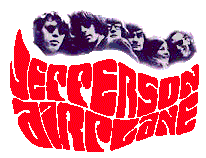
The music of the sixties defined as closely as possible this mystic-style awareness that was necessary to belong. In “Somebody To Love,” Jefferson Airplane sang your basic message song, with its instructional/invocational lyrics directed at the hippie neophyte, (the “HIS” of the first line I interpret to mean the eyes of Jesus on Sunday school posters, i.e., to look holy didn’t make you holy):
“I say your eyes may look like his, yeh
But in your head, baby,
I’m afraid you don’t know
Where it is.
Don’t you want somebody to love?
Don’t you need somebody to love?
Wouldn’t you love somebody to love?
You better find somebody to love!”
(Jefferson Airplane appear at Matrix simulation room regularly)
Jimi Hendrix’s guitar playing kind of arched with sexual passion, and the lyrics were just an added treat. In this song, ‘Are You Experienced?’ is contained a gentle invitation full of seductive reasoning, by the only black hippie I ever heard of:
"If you can just get your mind together,
Then come on across to me.
We’ll hold hands, and then
We’ll watch the sunrise
From the bottom of the sea.
But first, are you experienced?
Have you ever been experienced?
Well, I have."
Possible interpretations:
Have you ever gotten it on yet?
Can you qualify for this job?
Do you know the social ropes?
Have you experienced what we have
Experienced by daring to experience
An altered consciousness? If you
Are experienced, the you know there
Is no way to stay uptight. You can’t
Accept the absurd inherited way to
Function in the USA. We can see
Our parents were really lost on an
Excessive plane. We the children
Are returning to Earth, but gently,
As angels. There is a lot of joy
Floating around and we can feel it,
We can see it, because we’re not afraid.
... Another manifestation of linguistic intensity was the use of hyperbole, an overdoing of description, in an attempt to say, yes, it was greater than I can say, it was more than you can even imagine with your eyes! The best hippie story tellers mastered this exaggerated style when recounting acid experiences. After all, the hippie encountered bizarre situations, quaint juxtapositions every time he stepped out into the street, and the comparisons between him and the straight world were relentless: a lot of material out there.
This emphatic style was achieved through the heavy use of intensifiers: everything was “really” and “too much.” Expletives were adopted as a result of the recent free speech movement. (Thank you, Berkeley) because it was certainly absurd to allow anyone else to tell you what to say. Swear words also came in handy to express that extra dimension of emotion that the speaker was always trying to convey.
Informal grammar was a reactionary response to the social regulation of linguistic expression. I know the worse my grammar, the better I felt, as if at last I was speaking the speech of real people, that English class and my parents had never let me do before.
There was an almost compulsive use of pause words, filler words, such as ‘like,’ ‘man,’ ‘you know.’ Their use has been attributed to various causes, such as a stoned and sluggish mind, the fear of commitment. To me, it was a request for reassurance, for approval, as if to say, you do understand, don’t you, you have been there, too, haven’t you? Hippies were peaceful radicals, but radicals, nonetheless, and you can’t get too far on curiosity value alone.
Other linguistic characteristics of hippie speech were lengthened juncture, top-level stress gliding tones and deeply falling intonation. The nature of the lengthened juncture was its unexpected occurrence, where the speaker wanted to make a point, wanted to catch your attention before he would produce the key word. I call them pregnant pauses, true narrative devices.
Falling intonations are one of the most interesting markers of hippie speech, where the last word of an idea unit is dropped to practically below the lowest level intonation. Dr. Honsa (Foreign Languages, U.N.L.V.) relates this affectation to a N.Y. Jewish style: polite, submissive, non-threatening. I can connect this faraway style to the S.F Hippies through the influx of N.Y. Beatniks to the West Coast in the fifties.
The overall hippie style was intentionally casual, deliberately informal. The respectful mode was reserved for addressing gurus and crazies. The style could also be classified as a specific language game, where the participants had to keep signaling their mutual understanding and agreement on mystic experience, drug-related adventures and confrontations with straight society.
"Communication Gap" took on new meaning. Where the awareness of the purity of reality actually prevented hippies from entering in any other language set but their own, hallucinogenic drugs did have a way of destroying common ground. The deep (as in “Heavy”) structure of hippie talk was felt by its speakers to be definitely deeper than that of the mainstream American language. There’s that intensity factor, again, pushing ego buttons.
Acid just happened to turn up
As the product of this particular society,
To correct its own excesses.
Gary Snyder
... The key words, as related to an altered awareness, seem to be "Reality" and "Experience." The mystical properties contained therein are all embodies in one word, IT (as in, “Where IT is at,” “What IT is all about,” etc.) Michael McClure, the hippie poet and dramatist, put IT all in one poem: Mystic Awareness, Stress for Meaning, The Meditative Power of Language Itself:
"AND it is all perfect, this is really it.
And IT is all perfect, this is really it.
And it IS all perfect, this is really it.
And it is ALL perfect, this is really it.
And it is all PERFECT, this is really it.
And it is all perfect, THIS is really it.
And it is all perfect, this IS really it.
And it is all perfect, this is REALLY it.
And It is all perfect, this is really IT.
From the Editor: Art from Haight-Ashbury Quicksilver style! ~ The Zone * Mercury's Children - Quicksilver
Tolkien was introduced into the Haight community by Jane Peterson, who eventually became a resident transplant from Berkeley to an apartment on Delmar Street. Jane and poet-husband Robert rented from Tiff and Marylou Garcia (Tiff is Jerry's older brother.)
Visit Garcia here. ~ More blues background about R & R-Blues Hot Spot, The Both/and," frequently overlooked in Haight-Ashbury 'bio and documentary articles,' located at Haight and Divisadero, often featured the great bluesman John Lee Hooker.
'Boogie' over from here. ~ This John Howe image of Galadriel captures the spirit of mystic San Francisco and Marin nights. Look over excellent scans from
variety of Tolkien artists
Editor additional ~ Phyllis Fisher had been my next door neighbor in San Francisco. We shared several great stories about happenings at the Haight events, Avalon Ballroom and Fillmore. She and I joined everyone in the neighborhood for The Tribal Stomp at The Avalon and
the Three Days at The Glide. Her contributions to Rolling Stone are 'classic sixties' and the stories are true.
Most hippies dressed according to mood by day and activity by night as an interwoven mode over the Summer of Love psychedelic era. Most styles, inspired by a cross between Tolkien, Robin Hood and the Early American culture, have been classified by the noted, unique colour consultant, Suzanne Caygill. See Arwen's Fashion for more on her 'special types' and THE LORD OF THE RING costume designs by Ngila Dickson.
It follows another source dates back to earlier collective notes - lines from
Zora Neale Hurston’s
Glossary of Harlem Slang .
Cruising - parading down the Avenue. Variations: oozing, percolating, and free-wheeling. The latter implies more briskness.
Granny Grunt - a mythical character to whom most questions may be referred
I shot him lightly and he died politely - “I completely outdid him.”

Kitchen mechanic - a domestic
Lightly, slightly, and politely - doing things perfectly
Now you cookin’ with gas - now you’re talking, in the groove, etc.
Righteous rags - the components of a Harlem-style suit
Thousand on a plate - beans
Trucking - 1) strolling 2) dance step from the strolling motif

The Attentive Mind
Questioner to Krishnamurti: Yesterday after the meeting we saw you watching two peasant children, typically poor, playing by the roadside. We would like to know what sentiments arose in your mind while you were looking at them.
Krishnamurti: Yesterday afternoon several of the students met me on the road, and soon after I left them I saw the gardener’s two children playing. The questioner wants to know what feelings I had while I was watching those two children.
Now, what feelings do you have when you observe poor children? This is more important to find out than what I may have felt. Or are you always so busy going to your hostel or to your class that you never observe them at all?
Now,, when you observe those poor women carrying a heavy load to the market, or watch the peasant children playing in the mud with very little else to play with, who will not have the education that you are getting, who have no proper home, no cleanliness, insufficient clothing, inadequate food—when you observe all that, what is your reaction? It is very important to find out for yourself what your reaction is. I will tell you what mine was.
Those children have no proper place to sleep; the father and the mother are occupied all day long, with never a holiday; the children never know what I t is to be loved, to be cared for; the parents never sit down with them and tell them stories about the beauty of the earth and the heavens. .And what kind of society is it that has produced these circumstances—where there are immensely rich people who have everything on earth they want, and at the same time there are boys and girls who have nothing? What kind of society is it, and how has it come into being? You may revolutionize,, break the pattern of this society, but in the very breaking of it a new one is born which is again the same thing in another form—the commissars with their special houses in the country, the privileges, the uniforms, and so on down the line. This had happened after every revolution, the French, the Russian and the Chinese. And is it possible to create a society in which all this corruption and misery does not exist? It can be created only when you and I as individuals break away from the collective, when we are free of ambition and know what I t means to love. That was my whole reaction, in a flash.
But did you listen to what I said?
-J. Krishnamurti, Think on These Things [Harper & Row]
THE LORD OF THE RINGS: Moon-letters
The secret runes of the Dwarves
'Moon-letters are rune-letters, but you cannot see them,' said
Elrond, 'not when you look straight at them.'
The Hobbit 3, A Short Rest
A system of writing invented by Dwarves. Moon-letters were ordinary runes, but written in such a way that they could only be read when the light of the moon shone behind the writing. Some moon-letters could be read by any moonlight, but it was possible to make the writing even more secret. More sophisticated moon-letters could only be read by the same shape of moon, or at the same time of year, as when they were written.
Moon-letters were written with silver pens. The substance ithildin, made from mithril, reflected only starlight and moonlight, and it seems likely that ithildin, or something very similar, was used by the Dwarves to write their moon-letters.
Source:
The Encyclopedia of Arda
The Language of Numbers
Number 1 represents the principle of Unity which underlies all numbers. By multiplication it creates all others, but multiplied by itself to infinity it always retains its unity.
Odd numbers are considered sacred because when we attempt to divide them into equal parts they leave the Monad or the 1 God standing unaffected between them, thus: 3 = 1+1+1, 5 = 2+1+2, 7 = 3+1+3, etc. Thus they reveal the Supreme Deity in the midst of His works. Even numbers are those which can be divided into 2 equal parts without revealing the 1 God in their midst. When odd numbers are divided 1 part will always be odd—representing the Divine—and 1 even—representing the manifestation of the Divine…
James M. Barrie books online
San Francisco - Haight-Ashbury
the lab
Labyrinth Sheet Music
from
Jareth's Music Hall


10 Forward Star Trek galley, Indiana Jones Menu,
Innholders' Company,
It's All In The Sauce,
Jupiter Table,
magic spice,
Mercury Table,
Oracle's Lab,
shrmx,
smoothie,
star inn -Star Wars, tangerine,
vittles
| Top | Abramelin | Alchemy | Ancient Oracle | Articles | Artists ~ Rock & Roll | Astrology | Astroscape | Aura | Babylon 5 | Beat | beatles | Bus | Candles | Colour Waves | Constantine | Deva | Divination | Dowser | Early Heraldry | Energy Management | FAQ | Gladiator-Champion-Fighter | Haight-Ashbury | Heartwarmer * Bread & Roses | Hip | Hobbit Dowser - Nyll Greenwood | Hogwarts | House System * Sacred Tarot | Internal Spectrum | Lab | Mandala | Mask-Who Was That Masked Man? | Masked World | Matrix | Meditation Index | Middle-earth Inn | Mirror | Mountain | Mystique | Neutrals | Number 1-9 | 11-22-33 | Palm | Parapsychology |
Phoenix |
Pix | Quiz | Sacred Place | Shrine | Site |
Sixth Sense |
Son of Spooky | Space | Star Chart (by Zodiac) Listing | Star Trek | Star Wars | Still Zone |
Stonehenge | Tao | Transcription breaks | Transform | Tutoring |
Twitter | Unicorn | Unknown Museum |
Unnumbered Tarot | Us | US Time
| Valentine | Vote Star Charts | Wall | Wands | Whale | Wizard | Your Elf | Zone

|
|
